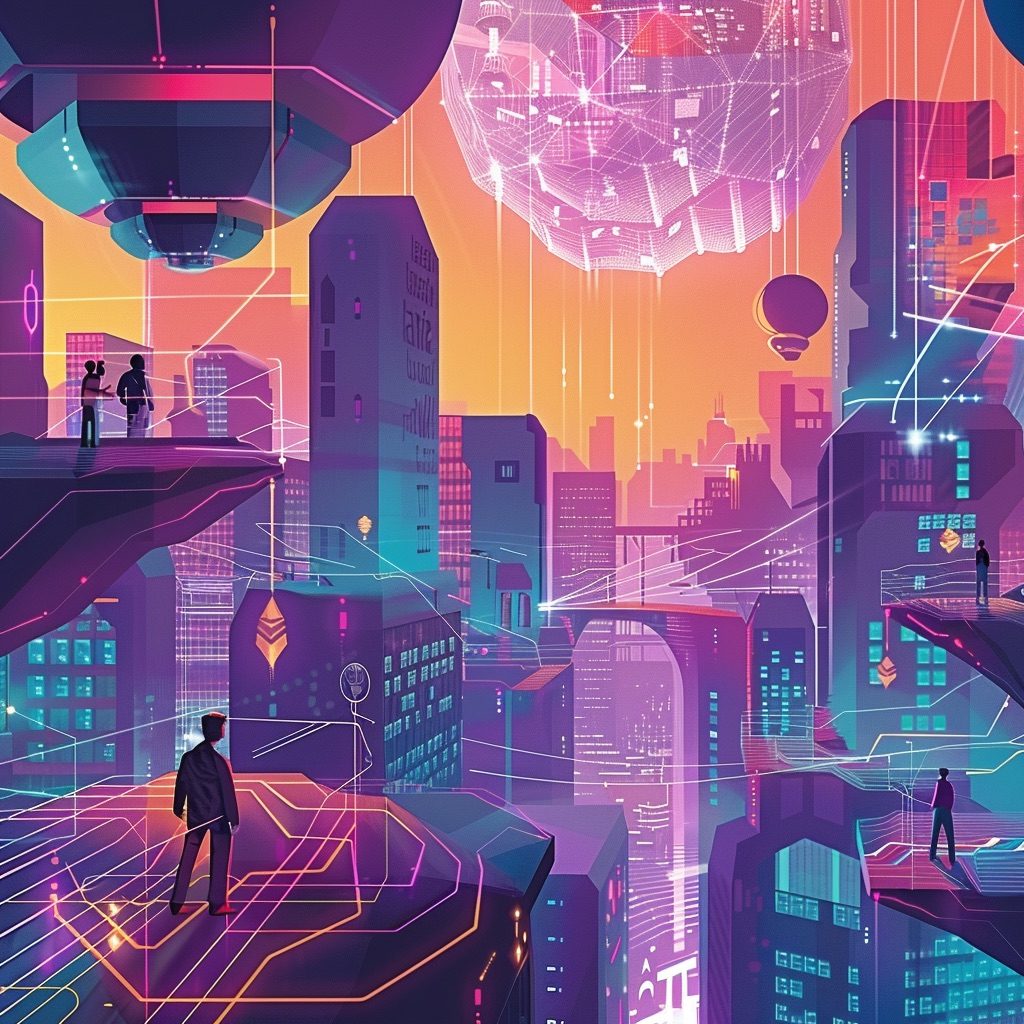
In 2026, humanity produces more information in a single day than our ancestors created in entire centuries. Yet we are more fragmented, more confused, and more alienated from one another than ever before.
This is not a glitch. This is the Great Fragmentation.
The Paradox of the Information Age
We carry devices in our pockets that give us instant access to nearly all human knowledge. We can talk to people on the other side of the planet in real time. Artificial intelligence can write essays, generate art, and answer complex questions in seconds.
And yet:
- Trust in institutions is at historic lows.
- Public discourse feels increasingly broken.
- People who share the same language often feel like they’re speaking completely different realities.
- Loneliness and mental health crises continue to rise even as we become more “connected.”
How did this happen?
The Flood
The internet didn’t just give us more information — it removed almost all friction from sharing it. Every opinion, every meme, every conspiracy theory, every scientific paper, every piece of propaganda now competes for the same limited resource: human attention.
The result is not enlightenment. It is noise.
AI has made this problem exponentially worse. Generative models can now create realistic text, images, and video at scale. What was once rare (high-quality information) has become common. What was once common (shared cultural ground) has become rare.
The Collapse of Shared Symbols
Throughout history, civilizations maintained cohesion through shared symbolic systems — myths, religions, languages, rituals, and cultural narratives that gave people a common map of reality.
Those old systems are dissolving under the pressure of the digital age. In their place, we have billions of micro-narratives, personalized algorithms, and echo chambers. Everyone has their own map. Almost no one shares the same territory anymore.
We are experiencing a crisis of meaning.
What This Means for the Future
This fragmentation is not just a social problem. It is becoming a civilizational one.
As artificial intelligence grows more powerful, the question of whose values, whose understanding, whose reality gets encoded into these systems becomes critical. If we cannot even agree on basic shared meaning among humans, how do we build AI that serves humanity rather than exploits its divisions?
The stakes are no longer abstract.
A Moment of Reckoning
The Great Fragmentation forces us to ask deeper questions:
- What does real understanding actually look like?
- Are there more fundamental ways to structure meaning than the messy, overloaded languages we currently use?
- Is it possible to build new symbolic systems that can help both humans and machines navigate reality more clearly?
These are not easy questions. But they are becoming unavoidable.
The old operating system of civilization is breaking down. The question now is whether we can consciously design something better — or whether we will simply let the fragmentation continue until something breaks that cannot be repaired.
I believe we still have a choice.
What do you think is driving the fragmentation you see in your own life? The conversation starts here.
This is the first in a series exploring the geometry hidden inside intelligence and the search for better ways to think together.